
Defrost in minutes,
not days
Global Food Technology is the UK and Ireland supplier of Stalam industrial radio-frequency thawing and tempering equipment for meat, poultry, fish, seafood, fruit and other frozen food products.
What is RF defrosting?
Radio frequency (RF) defrosting is a thermal-processing technology that dissipates electromagnetic energy inside a frozen product.
Unlike air, water or conventional methods — where heat is transferred from the surface inwards by conduction, convection or irradiation — an RF field generates heat directly and instantaneously throughout the entire product mass. This is why the mechanism is described as "endogenous" or "volumetric" heating, and it is what allows a rapid, uniform and accurately controlled defrost regardless of the product's size, weight, shape or thermal conductivity.
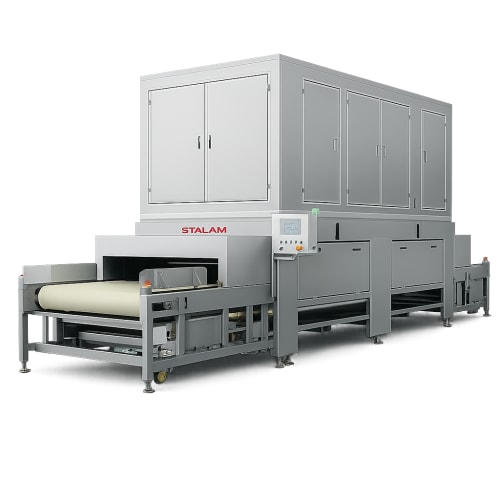
How RF defrosting works
Product enters the RF field
Product travels on a conveyor belt continuously through the RF tunnel, between an upper and a lower metal plate. These plates form an electrical capacitor, and the product between them becomes the dielectric element.
The field reverses millions of times a second
The plates connect to an RF generator oscillating at 27.12 MHz. The polar water molecules in the frozen product vibrate and rotate as they try to align with the rapidly reversing field polarity.
Heat is generated inside the product
That molecular friction generates heat rapidly and uniformly within the whole mass at once — not from the outside in. Because water is highly polar, RF heats frozen, water-bearing food extremely efficiently.
The process is precisely controlled
Heat and defrosting time are controlled accurately through the voltage on the plates and the conveyor belt speed, so product reaches exactly the target temperature for the next process.
The benefits
Minutes, not days
Even large blocks temper in minutes — and can be defrosted still inside their packaging.
No degradation
Speed and uniformity prevent bacterial growth and preserve texture, colour and quality.
In-line & just-in-time
Continuous operation integrates into the line, with flexibility for sudden or changing orders.
Less floor space
A fraction of the footprint of defrosting rooms, with no energy lost to ambient air.
What can be defrosted?

Meat & Poultry
Blocks and individual cuts, bone-in or boneless, lean or fat, naked or packaged — beef, pork, lamb, chicken and turkey. Tempered ready for grinding, slicing, dicing, forming, tumbling or marinating.
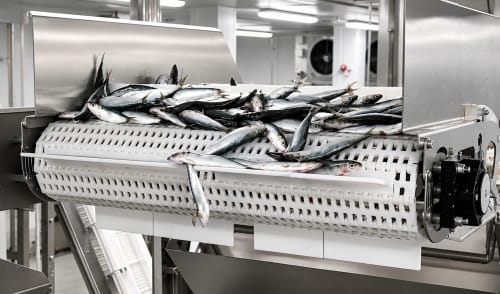
Fish & Seafood
IQF and blocks, whole fish, fillets, portions and minced fish, flat and round, with or without packaging. The gentle process preserves the physical, biological and nutritional integrity of fish and shellfish.
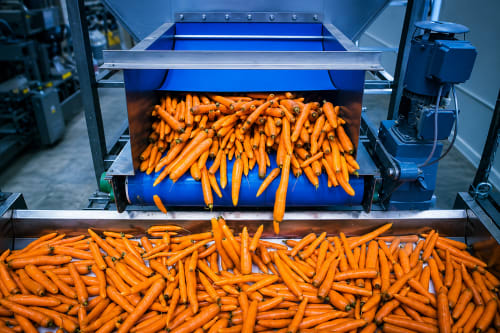
Fruit & Vegetables
All kinds of frozen fruit and vegetables — IQF or in blocks, bulk or packaged. RF tempering minimises drip loss so produce keeps its texture, flavour and freshness. Carrots, peas, spinach, strawberries and more.

Ready Meals, Dairy & Liquids
Ready meals for catering and retail, butter, margarine, soft cheese, liquid egg, fruit purées, juices and vegetable soups. Even delicate packaged products defrost evenly and gently, ready for the next step.
See RF defrosting in action
Real Stalam COLDWAVE+ installations defrosting frozen product by radio frequency.
Meat blocks
Fish & seafood (frozen prawns)
The Stalam COLDWAVE+ range
Global Food Technology supplies the Stalam COLDWAVE+, the market-leading in-line RF defroster. With more than 2,600 Stalam RF machines in operation across 70+ countries, the COLDWAVE+ is available from compact 7 kW units to high-capacity 105 kW systems. The latest COLDWAVE+ 2.0 generation adds a 5-position mobile upper electrode for greater versatility, an improved hygienic design for easier cleaning, energy-saving stand-by, and advanced on-board diagnostics.
| Model | Cooling | Belt width | Throughput to -3/-1°C | Throughput to -6/-4°C |
|---|---|---|---|---|
| 7 kW | Air | 0.6 m | 150–200 kg/h | 250–300 kg/h |
| 20 kW | Air | 1.4 m | 400–600 kg/h | 800–1000 kg/h |
| 40 kW | Air or water | 1.4 m | 800–1200 kg/h | 1500–2000 kg/h |
| 85 kW | Water | 1.8 m | 1500–2000 kg/h | 3000–4000 kg/h |
| 105 kW | Water | 1.8 m | 1500–3000 kg/h | 3000–5000 kg/h |
Throughput varies with product type, weight and target temperature. Figures based on 90% vl beef trimming blocks (55×35×18 cm, 27 kg) at -18°C. Multiple modules can be combined to increase capacity as production grows.
RF thawing vs other methods
Radio frequency is one of several ways to bring frozen food back to temperature. Here is how it compares with conventional thawing rooms, water thawing and microwave, so you can see where each fits.
| Method | Speed | Uniformity | Drip loss | Footprint | Best for |
|---|---|---|---|---|---|
| Radio frequency (RF) | Minutes | Excellent — core to surface | Very low | Compact, in-line | Blocks, cartons & IQF where yield and speed matter |
| Conventional thawing room | 1–3 days | Poor — warm outside, frozen core | High | Large refrigerated space | Low-value product where time is not critical |
| Water / brine thawing | Hours | Good for thin products | Moderate | Tanks & drainage | Fish and seafood, thinner formats |
| Microwave | Minutes | Uneven — prone to hot spots & edge cooking | Low–moderate | Compact | Small, thin products; harder to scale evenly |
RF vs microwave
Both use electromagnetic energy, but RF operates at a lower frequency with a longer wavelength, so it penetrates deep into large blocks far more evenly. Microwave energy is absorbed quickly at the surface, which causes hot spots and edge cooking on thick product. For industrial blocks and cartons, RF gives the uniform, core-to-surface result microwave struggles to achieve at scale.
RF vs conventional thawing
A thawing room relies on slow surface heat transfer over one to three days, which is uneven and encourages drip loss and bacterial growth in the warm, moist environment. RF heats the whole block volumetrically in minutes, protecting yield, hygiene and product quality while freeing up refrigerated floor space.
RF vs water thawing
Water thawing is gentle and well suited to fish and thinner formats, and Global Food Technology supplies Peruza water thawing lines for exactly these applications. For solid blocks, cartons and higher throughput where drip loss and water use matter, RF is usually the stronger choice. As a multi-brand supplier, we can recommend whichever genuinely fits your product.
Radio frequency defrosting FAQ
Straight answers to the questions food processors ask most often about RF defrosting, tempering and equipment.
What is radio frequency (RF) defrosting?
Radio frequency defrosting uses electromagnetic energy to generate heat directly inside frozen food. A high-frequency alternating field makes water molecules within the product vibrate, producing gentle internal warming that thaws or tempers large blocks in minutes rather than hours or days, without cooking the surface.
How long does RF defrosting take?
RF defrosting typically reduces thawing and tempering times from one to three days down to a matter of minutes. Exact times depend on product type, block size and target temperature, but the process is continuous and predictable, which makes production planning far simpler.
Does RF defrosting damage the product?
No. Because RF heats the whole block evenly rather than transferring heat slowly from the surface inwards, there are no hot edges or frozen centres. Products retain their texture, colour and structure, and there is no surface cooking or case hardening.
How much drip loss does RF defrosting cause?
Drip loss is substantially lower than with conventional thawing. Rapid, uniform heating minimises the temperature difference between the outside and core of the block, so products retain far more of their original weight, directly protecting yield and profitability.
Is RF defrosting hygienic?
Yes. RF defrosting is a clean, contact-free process that avoids the prolonged warm, moist conditions of traditional thawing rooms where bacteria multiply. The rapid, controlled heating keeps product within safe temperature ranges throughout.
What products can be defrosted with RF?
RF systems handle meat, poultry, fish, seafood, fruit, vegetables, ready meals and other frozen products. They suit solid blocks, cartons and IQF products, and are commonly used ahead of slicing, dicing, mincing, forming, cooking or further processing.
How much space does an RF defroster need?
Far less than a conventional thawing room. RF systems are compact in-line units that replace large refrigerated thawing areas, recovering valuable factory floor space. Multiple modules can be combined as production grows.
Who supplies RF defrosting equipment in the UK and Ireland?
Global Food Technology is the UK and Ireland supplier of Stalam industrial radio-frequency thawing and tempering equipment, providing sales, application advice, installation and ongoing support.
Independent advice, not one fixed machine
Many RF suppliers only make and sell their own equipment, so every problem looks like it needs their box. As a specialist food processing equipment supplier, we represent the best European manufacturers and recommend whatever genuinely suits your product, throughput and budget.
For radio-frequency thawing we supply Stalam, the world leader in industrial RF. But if water thawing or controlled-air tempering is a better fit for your fish, seafood or block formats, we also supply Peruza water thawing lines and Kometos thawing rooms and cabinets — and we will tell you honestly which one to choose.
Ready to defrost smarter?
See the full specification, models and brochure for the Stalam COLDWAVE+ RF defroster.
View the Stalam COLDWAVE+ defroster